Tutoring
In addition to my work as a professional writer, I am also a fully qualified teacher and tutor, working out of my home in Glasgow.
-
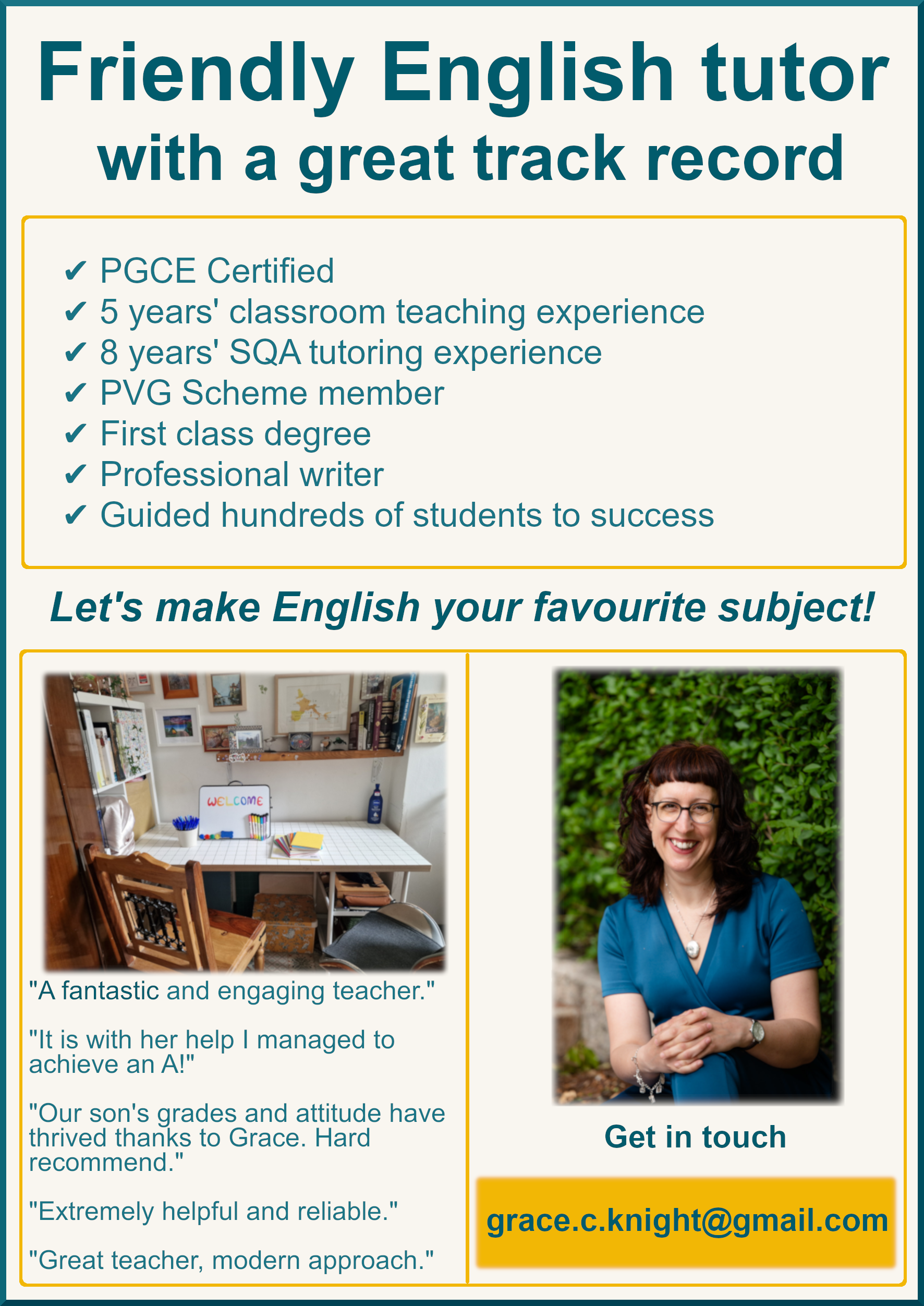
I have a first class degree in English Literature and Philosophy from Cardiff University, and a PGCE from the prestigious Institute of Education, as well as two PTLS qualifications. I am also a member of Disclosure Scotland’s PVG Scheme for working with children.
Outside of my teaching work, I am also a professional scriptwriter with many credits across film, TV, audio drama, and theatre. I love all aspects of my work. I love to find the perfect way to communicate an idea, and I love to help people find their personal path into a love of, and ownership of, literary art. I feel very privileged to get to do those things as both a teacher and a writer.
-
In my five years as a classroom English teacher I guided hundreds of students through their exams, tailoring my methods to meet the needs of a wide range of different learning styles. During one to one tutoring, I take great pleasure in having the space to really get to know, and meet, the particular learning needs of each student.
As an AS and A Level teacher (equivalent to Higher and Advanced Higher), I've helped students achieve 100% in their English exams, and as a GCSE teacher (equivalent to National 5), I've helped D grade students successfully achieve Bs and As. In my GCSE English re-sit classes (in which every student had previously achieved a grade D), my pass rate at C or above was always at least 85%.
As a private tutor, I have been working with National 5, Higher, and Advanced Higher students in Glasgow since 2018. I am therefore very familiar with the SQA syllabus, and with supporting students through it.
I have also recently become interested in working with students on building up their foundational literacy skills. This is a crucial area of study, but although it appears on high school English mark schemes, it is totally absent from the curriculum. A focus on it can make a huge difference to dyslexic students, or those whose home language is not English, in particular. I work with the National Strategy Literacy Progress Units for Phonics, Spelling, and Sentences for this.
-
'I've never been taught by anyone as enthusiastic and invested in my education as Grace. Not only is she a fantastic and engaging teacher, but she really cares about your wellbeing too.' - Coby
'Grace encouraged me to see my strengths in English and helped me immensely in each and every session. I am certain that it is with her help I managed to achieve an A!' - Aisha
'You have been extremely helpful and reliable. I really enjoyed the way you taught me and would recommend you to any pupil sitting Higher English.' - Karen
'As a parent, I am so incredibly happy with the work Grace has put in with our son. Her positivity and passion, combined with her command of the curriculum, is joyful and infectious and to see how he has grown in ability and, even more importantly, in confidence, is wonderful. Working with Grace, his grades have improved not only in English but across the board as she has given him key exam techniques. His grades and attitude have thrived thanks to Grace. Hard recommend.' - Ali
'Great teacher, modern approach. My daughter really enjoyed it. Will prepare your child for an excellent grade. Thank you Grace.' - Lena
-
I always begin my lessons by asking my student what they would like to do today.
Sometimes, the answer is extremely specific - I have had students tell me that what they really want to do is learn how to use an apostrophe correctly! Sometimes, the answer is more general - that they want to get better at answering the analysis questions in the RUAE paper, for example.
Sometimes, they don't know exactly what they need, just that they want to be better at English. In those cases, I usually start by asking them to produce a piece of writing for me that I can look at, and then I use my professional expertise to decide what I feel is holding them back. We might do some work on how to structure an essay so that it really follows a clear line of thought, or get to grips with a particular poem or scene of a play they're studying, or I might teach them how to proof read effectively.
Often, I find that there are several different areas in which they need support. In that case we will probably split the session and, for example, spend some time on getting to grips with poetry analysis, and some on foundational literacy and grammar. This is often overlooked in teaching, because it isn't actually on the secondary syllabus, but it can seriously limit how well students do if the knowledge isn't there, and I find that just spending a little time on understanding where the full stops should go, or how to punctuate speech, can make a huge difference to their results.
In terms of how I teach, that varies a lot based on who my student is, and what works for them. Some people benefit from lots of chat, some need to be up on their feet and moving their body regularly or they can't concentrate. Some people like to just sit and quietly work through past papers together. Whatever works for them, works for me. I am here to facilitate and support their development, and I will be as flexible as I need to be to make it happen.
I suppose the other important thing about my lessons is that they are fun! I love my subject, and I believe strongly that it is only when people can take real ownership of the subject, and find ways to genuinely enjoy it, that they will really show us what they can do.