Wheat Googling #3: How do I reduce the number of sailors required to sail a frigate?
Hello!
Today, I am trying to reduce the number of sailors who are needed to sail the ship in my game. You might remember that in my last newsletter, I designed a new shift pattern for the sailors - one that would allow everyone eight consecutive hours of sleep, and plenty of time off. I built it around dividing the crew into six teams. I’m pretty happy with it, but of course it is based on a fantasy. Frigates during the Age of Sail typically required something like 100 people to actually sail them, and they didn’t have anything like enough space to accommodate the 600 people my system would require. So that crew requirement is going to have to go down.
How did the merchant navy reduce the number of sailors they needed to carry?
The royal navy didn’t bother to reduce the number of sailors required to work the ship, because they needed so many people to work the guns anyway that there was no point. But luckily for me, the merchant navy were very keen to pay fewer sailors to transport their goods. So keen in fact that by the end of the Age of Sail, they had managed to get the number down from about 100 on a frigate in 1800, to about 13 on a clipper towards the end of the century.
As far as I can tell, there were basically three innovations that made this change possible.
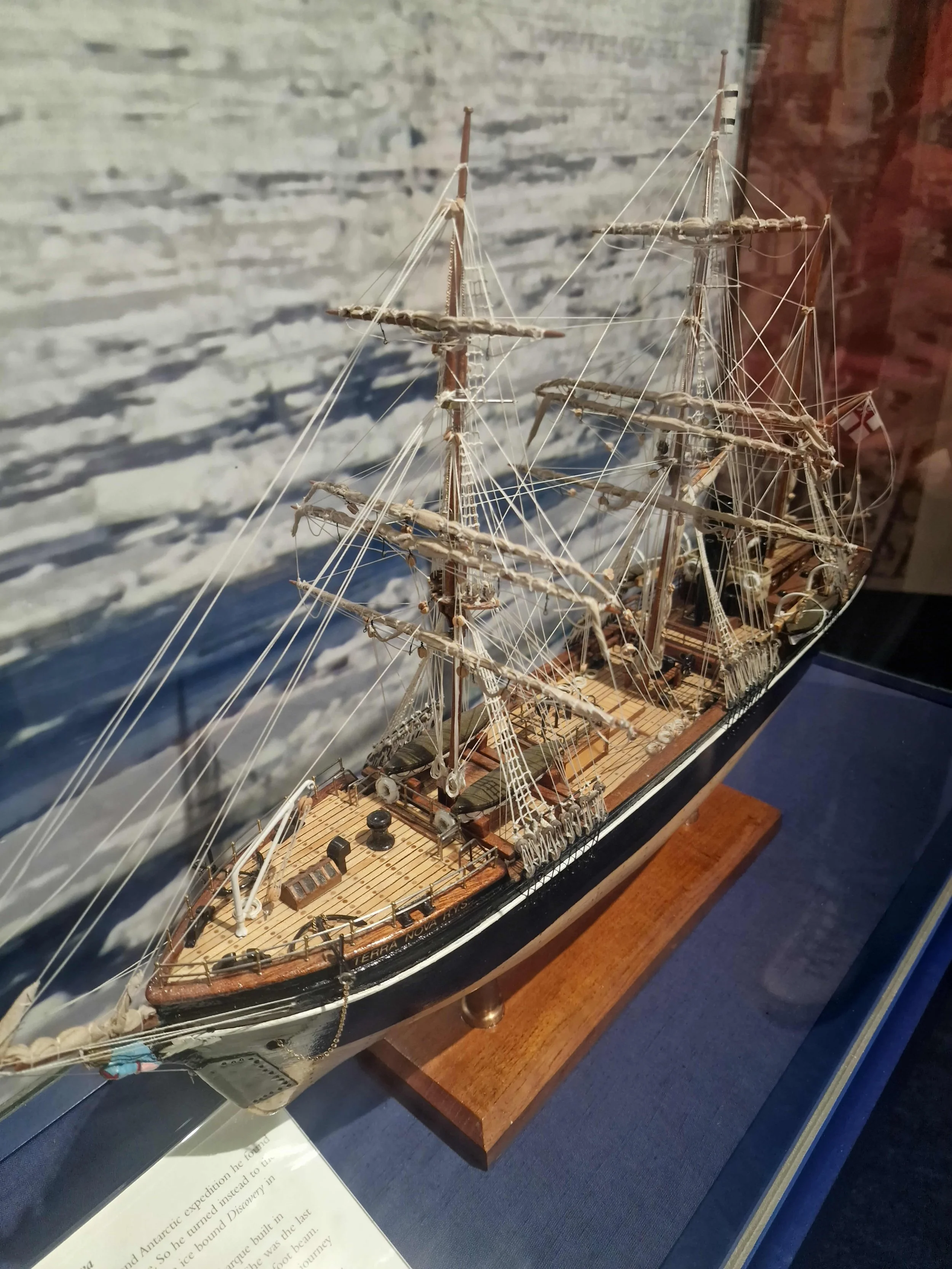
See those two horizontal yards that are really close together in the middle of the masts? Those are the split topsails.
Innovation #1: split topsails
The biggest sails on the ship were the topsails (confusingly, not the ones at the top, but the big ones in the middle of the mast). They needed about 20 people to handle them because they were just so heavy. By splitting them into two smaller sails, you could half the number of people you needed. It was also a lot safer for the crew because they could handle these sails from the deck, so they didn’t have to go aloft as often.
Innovation #2: the brace winch
Basically, the way you get a sailing ship to change direction is to change the angle of the long horizonal supports that hold up the sails (called “yards”). Traditionally, it took about twenty people pushing to move even one yard. But the brace winch made it possible for about two people to move three at once.
Innovation #3: the geared capstan
This was adopted in about 1850, and its use of gears made it possible for about four people to turn it when they needed to haul in the anchor, rather than about 40. Conveniently, it only took up about the same amount of space.
But how many sailors would a frigate need?
In real life, all these innovations came at pretty much the point when warships had largely transitioned to steel, iron, and steam, and got rid of their sails. But the navy in my story has always been, for reasons I will probably go into at some point, highly motivated to figure out ways to reduce crew size while still firmly within the Age of Sail. Motivated enough, I think, that I can reasonably push all these innovations forward 60 years or so.
But then I got stuck. I can point to sailing ships that had all those innovations. The Cutty Sark, for example, could operate with an active crew of about 12, and clippers were famously fast. The Discovery had a deck crew of about 20, and was famously tough. But warships were tough, fast, and maneuverable (well, the good ones were). So it has involved some digging to come up with an actual number for how many people would be required to sail my hypothetical frigate. And when I say digging, I mean getting ridiculously lucky and finding an expert to ask.
My incredibly patient family had agreed to yet another trip to visit Glasgow’s own tall ship, the Glenlee. I was initially disappointed, and then swiftly delighted, to discover that it was closed while the masts and rigging were repaired. Which meant that if I pressed my nose to the security fence, I could see actual real life riggers doing actual real life work on the mast! Even better, when I got chatting to them, I found out I was talking to basically the UK’s top expert in tall ship rigging, Jim Dines. He has been the nautical advisor and rigger on basically every film with a ship in it you’ve ever seen!
So I asked him.
If you took a frigate from 1812, then retrofitted it with every significant innovation of the following 60 years (not including steam), how many people would it take to crew it for full speed and maneuverability?
He pointed out that there sort of are ships like that: there are giant racing yachts. And he told me that they usually have a crew of 50. That’s 50 people working seamlessly together to get every inch of speed out of their ship, hardly moving as they stay in one place doing their one really specific job. So that’s the answer I’m going with. 50 people to sail the ship as well as it’s possible to sail it.
Then I asked my second question.
How many people would you need just to keep the ship ticking over?
He shrugged. “Ten.”
Ten! Slight changes in course can be managed from the deck using the brace winches, but if you want to actually take in or set a sail, you need ten people to do it. So that’s the limiting factor. I was astonished. Ten! If you’ve read as many Patrick O’Brian novels as I have, the idea of a ship like that being adequately crewed by ten people is absolutely wild!
What shall I do?
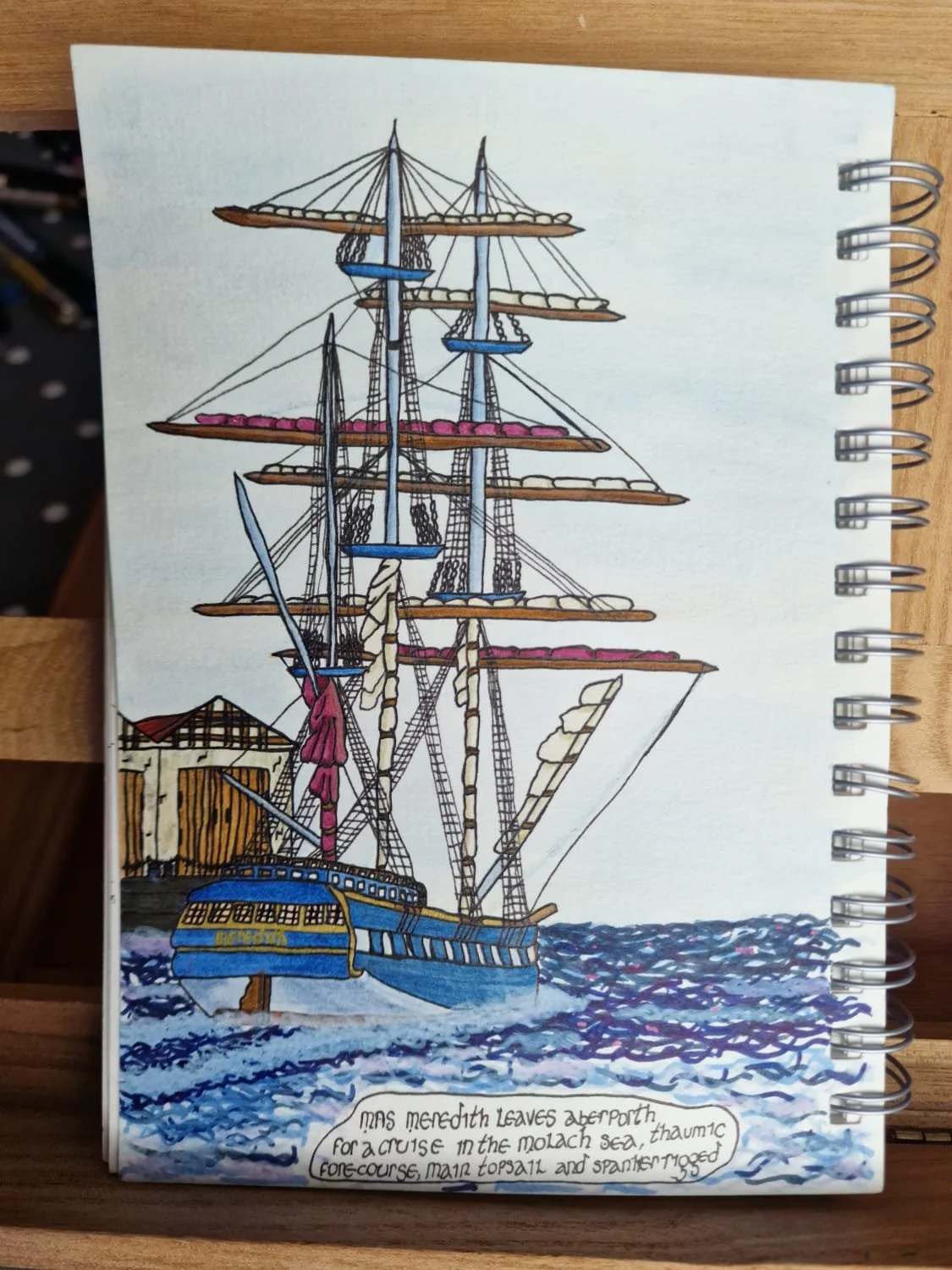
This does mean I will have to re-draw my picture of the ship from my game…
Well, I have my answer. I need at least 50 sailors who can answer the call of, “All hands on deck!” But I actually only need 10 per watch. And that works perfectly with the six watch system I have invented, while also building in a fair amount of redundancy for if people are sick or hurt.
But it’s going to change my setting a lot. I’ve been imagining a crew of 300 people crammed into their ship, sleeping shoulder to shoulder in hammocks, and the thunder of feet as they all go to their dinner at once. Now, I’ve got what I wanted: a powerful warship with a vastly reduced crew. But I feel like I’ve lost something.
I think it’s because I grew up on Hornblower novels, and then grew further up on Patrick O’Brian. It feels right to me to have hammocks piped up at breakfast, and terrible food, and overcrowding. In some way I can’t quite explain to myself, the presence of hundreds of poorly treated and often literally kidnapped sailors providing a backdrop for my story about a young lieutenant seems to be part of the promise of the premise. But why? Is it a feeling of satisfaction that comes from engaging in the gritty realities of the situation (albeit doubly vicariously since the point of view characters usually get much nicer living standards)? Is it just that it’s familiar, and nostalgically attractive? Is it that I have read a great deal of British fiction and most of it can’t really tell the difference between ‘cosy’ and ‘classist’. Maybe it’s just that it’s aesthetically striking. I don’t know. But whatever the reason, it’s got to go.
Enjoy the rest of your day!
Grace xx
PS: Any theories about where this feeling comes from that harsh treatment makes things more proper?
Next time
Next time, I want to look into what features happy societies tend to share, so I can try to make it possible on my ship.
This week’s interesting link
A Brief Look into Square-Rigged Sailing Ship Innovations (link)
A nice overview of the history.